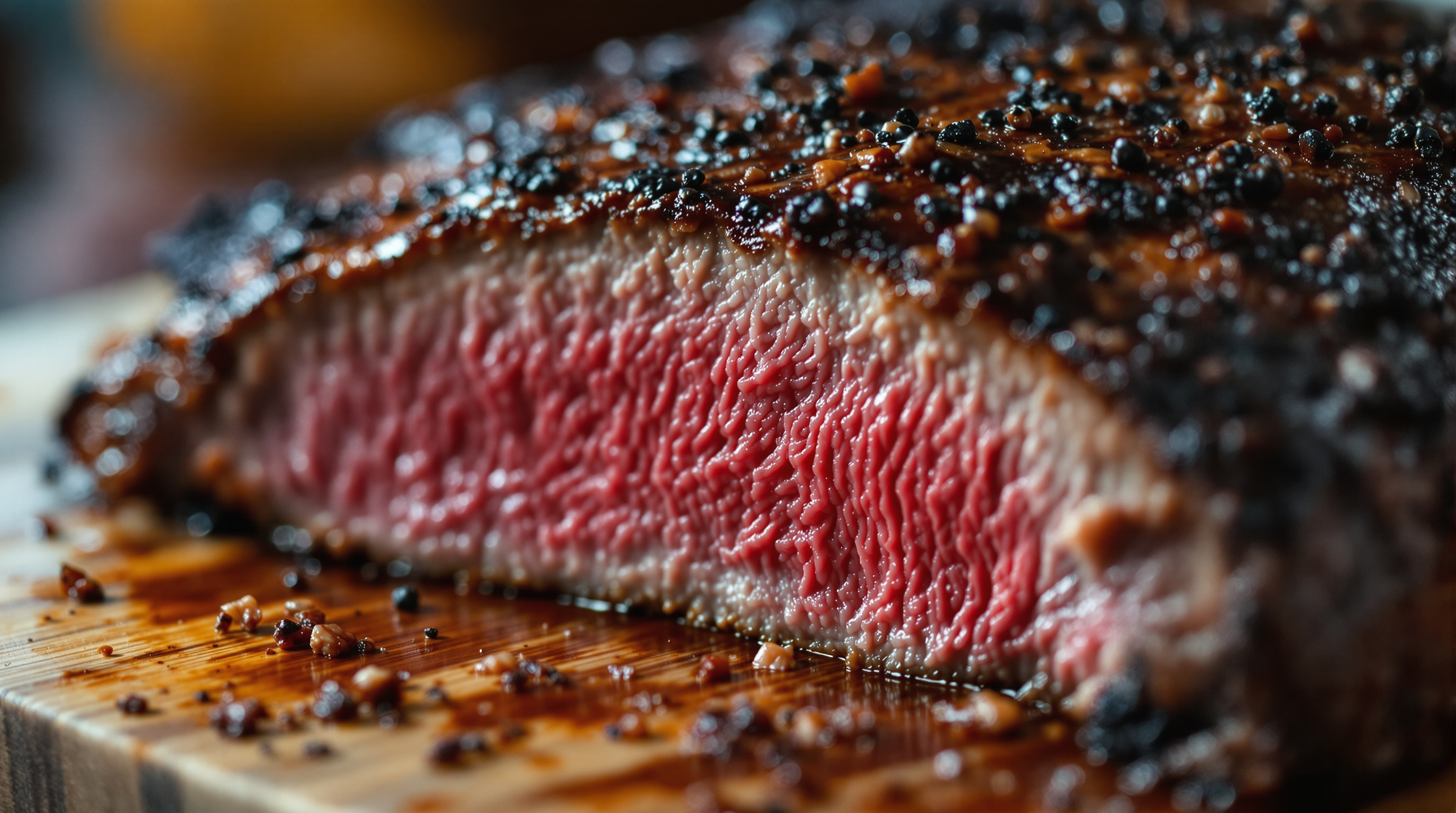
The short answer
A smoke ring is a chemical reaction, not a smoke stain. It forms when gases produced by burning wood or charcoal react with pigments in the meat, locking in a pink color that survives cooking. It is a sign that meat spent a long time in a smoky, low-temperature environment — which is exactly what good barbecue requires.
The science, in plain English
Meat gets its color from a protein called myoglobin. When you burn wood or charcoal, combustion produces nitrogen dioxide gas. As that gas settles onto the cool, moist surface of the meat, it dissolves and converts to nitric oxide, which soaks into the outer layer and binds with myoglobin. That bond fixes the pigment as pink so it will not turn gray-brown as the meat cooks through. The ring stops where the gas can no longer penetrate — usually a few millimeters in — which is why it looks like a defined ring rather than a gradient.
Carbon monoxide from the fire plays a supporting role in the same reaction. The chemistry is closely related to what happens when meat is cured: nitrites in cured ham and bacon fix that same pink color. Your smoke ring is, in effect, a light natural cure happening at the surface. The American Chemical Society and university meat-science programs such as those catalogued by the American Meat Science Association have documented the nitric-oxide-and-myoglobin pathway in detail.
How to get a better smoke ring
You cannot fake a real ring with liquid smoke, but you can encourage a deep one:
- Start cold. The reaction happens while the surface is still cool and damp. Put meat on straight from the refrigerator; do not let it come to room temperature first.
- Keep the surface moist. A wet surface absorbs the gases better. Spritzing during the early hours helps, as does a humid cooker.
- Burn real wood or charcoal. Nitrogen dioxide comes from combustion. Gas grills and most pellet cookers produce a fainter ring because they burn cleaner and hotter.
- Go low and slow. A long stretch at 225–275°F gives the reaction time to work before the meat's exterior sets.
Three myths worth retiring
First, liquid smoke does not produce a ring. It carries smoke flavour but none of the combustion gases the reaction depends on, so it colours nothing. Second, a pink rub is not a shortcut — paprika and chilli powder tint the bark, not the band beneath it, and the two are easy to confuse on a photograph. Third, and most usefully: a pink band near the surface is not evidence that the meat is undercooked. The colour is a fixed pigment that survives well past the point of doneness, which is why a properly cooked brisket can look rosy at the edge and be entirely finished. Doneness is a thermometer question, never a colour question.
A word of perspective
A gorgeous smoke ring looks fantastic on a sliced brisket, but seasoned pitmasters will tell you it is cosmetic. It does not add flavor, and its absence does not mean the barbecue is bad — competition judges are actually instructed not to reward it, precisely because it can be manipulated. Chase flavor, tenderness, and a good handle on your fire first; treat the ring as a happy bonus. Cook everything to a safe internal temperature and let large cuts rest before slicing.
Ready to put it into practice? Try our guides to smoked beef ribs and prime rib, or learn to build the pit that will give you rings for years.